a fuxxing joke
There has been a lot of discussion about the 28 points the Trump administration proposed as a so-called peace deal. My reaction is simple: it is a fuxxing joke.
To be clear, I am not speaking from what people often stereotype as the typical liberal protestor viewpoint. I know exactly how certain people on the right dismiss anyone who opposes war, especially those who protest about the situation in Palestine, by saying they are just trying to be woke. I reject that dismissal completely, and I want to make it clear that my position here is not coming from that lens. I have also written before about why students should be allowed to protest about Palestine and Israel, but even that did not come from a liberal position. If you are interested, you can have a read.
My frustration here comes from a historical point of view and from a deep disgust at how expansion and invasion are being repackaged as legitimate statecraft. The Chamberlain moment before World War II, when the British prime minister proudly waved Hitler’s signed promise that Germany would not invade Poland, is one of the clearest examples of Western naivety in modern history. Every student who studies that era learns about it.
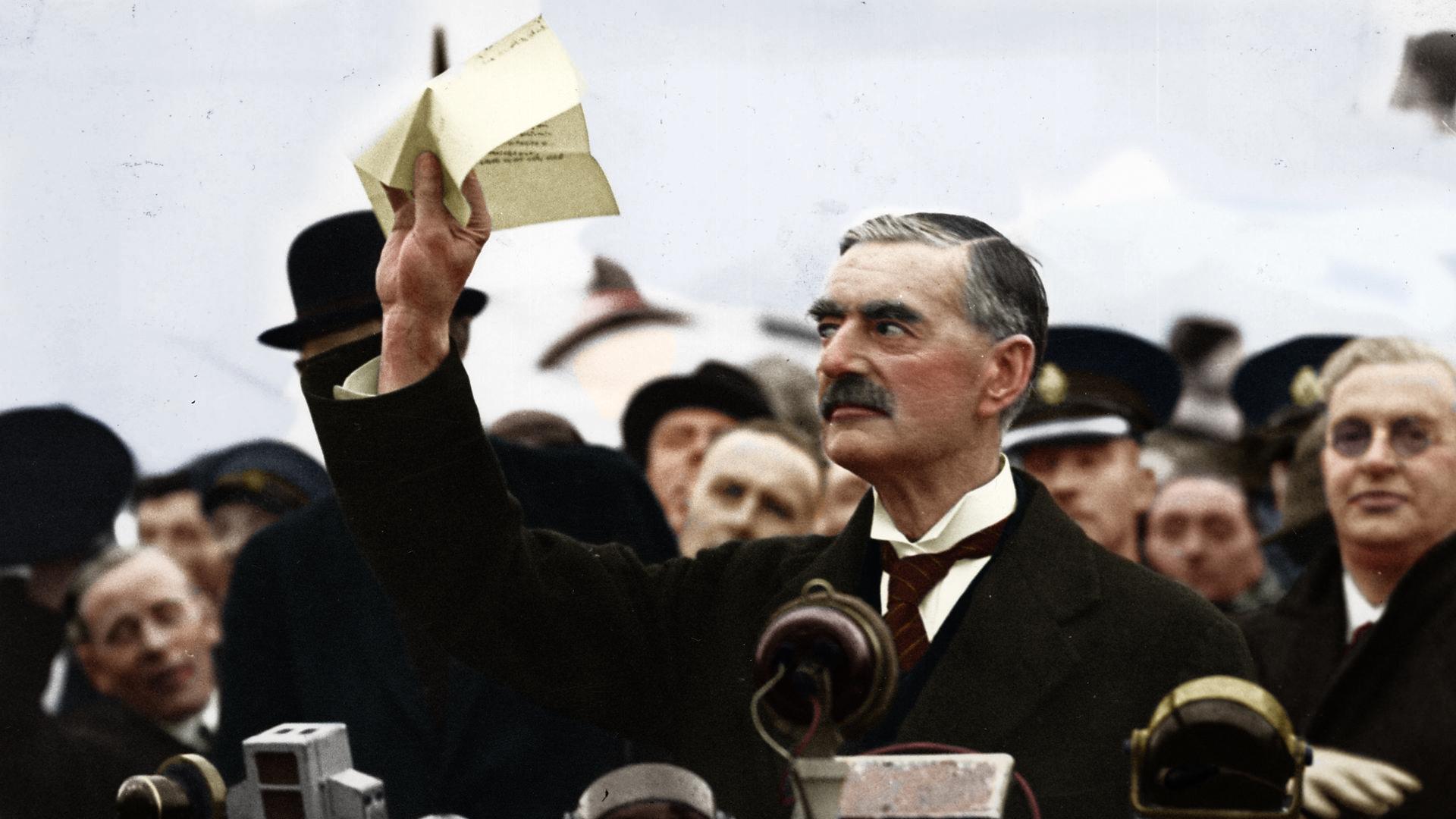
A famous photograph from September 30, 1938, shows British Prime Minister Neville Chamberlain standing before a crowd at Heston Aerodrome, holding aloft the Munich Agreement and declaring he had secured “peace for our time.”
And somehow we are watching that same pattern repeat itself. I never thought such obvious stupidity would return in this exact form, but history has a habit of circling back.
When I talk to people who oppose funding Ukraine, the common line is this: why do we care about them and why are we spending billions. Yes, the United States has spent about 130 billion dollars. And I understand the resentment. The national debt is exploding and domestic issues demand attention.
But almost no one realizes this piece of history. The United States, the United Kingdom, and Russia pressured Ukraine to give up the massive nuclear arsenal it inherited when the USSR collapsed. In exchange, they issued the so-called security assurances in the Budapest Memorandum. These assurances were not legally binding, and realistically no one could enforce them anyway, yet the entire deal rested on the expectation that Ukraine’s sovereignty would be protected if violated. Ukraine gave up the world’s third largest nuclear stockpile because it trusted those assurances.
Reality is brutal. Agreements get twisted. Great powers do what they want. But the fact that one signer of the arrangement is invading Ukraine, while the others pressure Ukraine to accept a humiliating deal that rewards aggression, should alarm anyone who understands how international commitments shape future conflicts.
Here are the exact clauses that demand attention:
5. Ukraine will receive reliable security guarantees.
Note: A separate document details the terms of the security guarantee. The United States and its NATO allies would treat an attack on Ukraine as an attack on the entire transatlantic community.
6. The size of the Ukrainian Armed Forces will be limited to 600,000 personnel.
Note: Ukraine’s army currently has 800,000 to 850,000 personnel, and had around 250,000 before the war.
7. Ukraine agrees to enshrine in its constitution that it will not join NATO, and NATO agrees to include in its statutes a provision that Ukraine will not be admitted in the future.
8. NATO agrees not to station troops in Ukraine.
21. Territories:
Crimea, Luhansk and Donetsk will be recognized as de facto Russian, including by the United States. Kherson and Zaporizhzhia will be frozen along the line of contact, which will mean de facto recognition along the line of contact.
Russia will relinquish other agreed territories it controls outside the five regions.
Ukrainian forces will withdraw from the part of Donetsk Oblast that they currently control, and this withdrawal zone will be considered a neutral demilitarized buffer zone, internationally recognized as territory belonging to the Russian Federation. Russian forces will not enter this demilitarized zone.
26. All parties involved in this conflict will receive full amnesty for their actions during the war and agree not to make any claims or consider any complaints in the future.
A simple look at these clauses shows exactly what is happening. The United States is essentially adopting Putin’s stated objectives. It validates his justification for invading. It limits Ukraine’s ability to defend itself in the future. It formalizes territory seizures. And even though the agreement claims NATO and the United States would defend Ukraine, who on earth would trust that promise? If Russia invaded again, would the United States and NATO really risk a full-scale war? It is a fuxxing joke to the families who lost loved ones and trusted their Western partners.
On top of that, the proposal offers full amnesty to war criminals who committed atrocities that meet every definition of genocide.
I genuinely struggle to understand the logic here from the perspective of the United States or NATO. Yes, supporting Ukraine is costly. Yes, casualties are devastating. And yes, Russia has been gaining territory while Western support wavers. Maybe Russia would not even accept these terms. But what happens when Russia comes back again? What happens when it invades Ukraine a second time or marches into another neighbor? Are we going to shrug and look away again, the same way the world did when Hitler tore through treaty after treaty? Is that really the precedent we want to set?
For Ukrainians, every option is painful. President Zelensky has said as much. The only supposed benefit is that the war stops, and Ukraine receives yet another set of sugar coated promises from the West, the same West that failed to honor its commitments when it mattered. The blood spilled defending their homeland would be swept aside for a temporary silence in the fighting.
If I were Ukrainian, I honestly do not know what choice I would make.
As a South Korean, though, I understand what it feels like for your country’s fate to be shaped by larger powers around you. China, Japan, Russia, and the United States have always pulled the strings in our region. I did not live through the Korean War, but the consequences are still with us every day. Living in the South while the North remains trapped in misery creates a kind of guilt that never fully disappears. Watching my country face diplomatic pressure from China while trying to maintain security through the United States makes it easy for me to empathize with Ukraine.
So let me end with this.
We might laugh at the possibility of history repeating itself, but history has already shown that it does. And it is a fuxxing joke that the United States, which claims to defend democracy and stand against authoritarian aggression, is now pressuring the very country it promised to protect into accepting a deal that undermines everything we said we valued.